


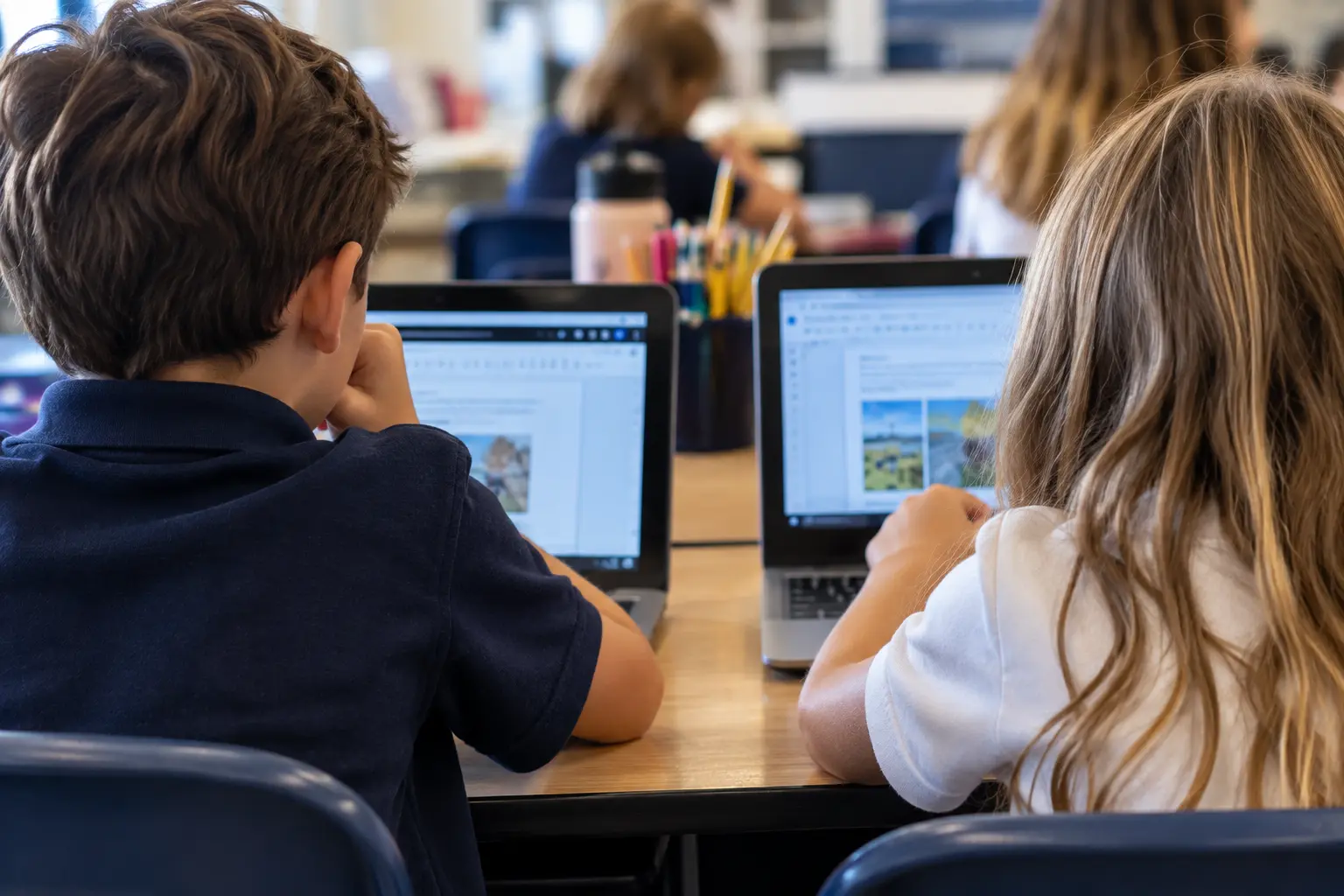
A new candidate questionnaire from PAUSE is giving Beverly Hills voters one of the clearest issue-by-issue comparisons yet of where candidates for the Beverly Hills Unified School District Board of Education stand on classroom technology, smartphones and artificial intelligence.
PAUSE, short for Promoting Alternatives to Unhealthy Screen Exposure, is a Beverly Hills parent-led group focused on reducing unhealthy screen exposure among children and encouraging families to delay smartphone use. The local group has also promoted the national Wait Until 8th Pledge, which asks families to wait until at least the end of eighth grade before giving children smartphones.
PAUSE invited all five candidates seeking two seats on the Board to answer 11 questions covering BHUSD's recently adopted technology policy, teacher support, student cellphone restrictions, artificial intelligence, the Wait Until 8th Pledge and alternatives to screen-based activities.
Jared Gonzales, Jackie Kruger, Kimberly Lifschitz and David Cienfuegos submitted responses. Board President Judy Manouchehri did not respond to the questionnaire, according to PAUSE.
PAUSE states that the candidates' answers were published exactly as submitted and arranged by question rather than by candidate.
Read together, the responses show substantial agreement that younger students need less technology and that smartphones can interfere with learning. But beneath that agreement are meaningful differences over AI, how restrictive BHUSD should become, how much authority teachers should retain and what the district should do next.
The questionnaire begins with Board Policy 6163.47, Intentional Technology Use in the Classroom, Digital Learning, and Artificial Intelligence Education. The Board unanimously adopted the policy in July after months of discussion and community advocacy.
The policy already establishes significant restrictions. TK through second-grade students are not assigned one-to-one devices, except for required assessments, teacher-led activities and legally required accommodations. Third through fifth grades emphasize handwriting, physical books, paper-based mathematics and direct teacher interaction while introducing structured technology instruction. Middle school students receive instruction in areas including AI literacy, cybersecurity, coding and digital citizenship. High school students move toward more advanced technology and AI education.
Gonzales called the policy "a strong step forward," but said he would go further by ending one-to-one devices for sixth- and seventh-grade students and providing devices only as needed. He also called for a more comprehensive AI policy, clearer definitions, additional family education and stronger accountability for implementation.
Kruger focused heavily on implementation. She argued that the policy lacks sufficient measurement and follow-through and said the district should track screen time and student outcomes and publicly report the results each year.
She also characterized the policy as treating AI "mainly as a threat" and argued that students need an educator-approved way to learn with the technology.
That characterization is worth examining against the policy itself. BHUSD's framework does not simply restrict AI. It specifically expands AI literacy as students advance through school, including annual AI instruction at the middle-school level and advanced technology preparation in high school. The district has since launched an AI Task Force and is exploring AI education as part of graduation preparation.
Lifschitz took a different approach, focusing on technology contracts, internet filtering and the process for reviewing the policy. She called for greater public information about educational technology products purchased by the district and proposed a filtering system in which websites would require approval before students could access them.
Cienfuegos used his response to emphasize his role in the development of BP 6163.47. He said he presented a redlined version of the proposed policy before its adoption and that nearly all of his recommendations were ultimately incorporated. He said his next priorities would include adopting his remaining recommendations, further restricting unnecessary screen-based homework in TK-8 and holding the district accountable for implementation.
The candidates also separated themselves over smartphones.
Gonzales said he favors a balanced approach and would promote basic phones without social media and gaming capabilities while evaluating whether BHUSD's existing rules are being adequately enforced.
Kruger proposed smartphone-free school days for TK-8 students and phones put away during instruction at the high school level, along with secure storage and exceptions for emergencies, medical needs and individualized education programs.
Lifschitz went further on physical control of devices, proposing that BHUSD consider phone pouches during the school day. She acknowledged likely resistance from parents who want immediate access to their children during emergencies but argued that student cellphone use during an emergency could create additional problems.
Cienfuegos supported a phone-free school day for elementary and middle school students, including lunch, recess and passing periods. He also specifically included smartwatches in his proposed restrictions so texting and social-media distractions do not simply migrate to another device. For high school students, he would allow phones to remain available but require them to be silenced and stored during instructional time unless authorized by a teacher or covered by an appropriate exception.
The discussion comes as California districts are already required to have policies limiting or prohibiting smartphone use under the state's Phone-Free School Act, making the debate less about whether restrictions should exist and increasingly about how extensive those restrictions should be.
The sharpest philosophical differences in the PAUSE questionnaire emerge around artificial intelligence.
All four responding candidates expressed concern that students could use AI to avoid developing independent thinking and foundational academic skills. Their proposed solutions, however, differ considerably.
Gonzales described AI as one of the largest classroom challenges he has encountered as a teacher since 2022. He said he moved his own math classes to paper-and-pencil assignments and wants BHUSD's use of AI to enhance rather than replace critical thinking.
Kruger favors approved and privacy-vetted AI tools designed to tutor students rather than simply provide answers. She called for grade-specific rules, additional in-class writing and assessments, and AI literacy and ethics instruction for high school students.
Lifschitz offered the most restrictive AI proposal of the four candidates. She said she would support a moratorium or temporary ban on generative AI in BHUSD schools and on district devices and also encouraged administrators and teachers to avoid using AI to produce materials such as flyers and handouts whenever possible.
Her proposal is not without precedent. Los Angeles Unified recently imposed a moratorium on student use of generative AI on district-owned devices, while New York City Public Schools instituted a moratorium on student-facing generative AI for students through eighth grade while allowing limited, supervised AI use and AI literacy instruction at the high-school level.
Cienfuegos drew a line based largely on age. He said he opposes elementary and middle school students using AI to complete schoolwork but supports advanced AI education in high school, including practical applications, technical skills, ethics and evaluating accuracy. Students using AI with authorization, he said, should disclose that use and be capable of explaining and defending their work.
That position is closely aligned with the basic structure BHUSD has already adopted: protecting foundational learning in the earlier grades while increasing structured technology and AI education as students mature.
The candidates also addressed a question that receives less attention in debates over technology: what students should do when the screens are turned off.
Gonzales proposed mentorship programs connecting younger and older students, student teaching-assistant opportunities and community activities centered on in-person interaction.
Kruger called for games, clubs, maker spaces, library time, arts, music and intramural sports, along with phone-free gathering spaces for teenagers.
Lifschitz focused on physical infrastructure and communal spaces, describing Beverly Hills as "park poor" and suggesting playgrounds, a pump track and additional recreational facilities accessible to students outside school hours.
Cienfuegos proposed sports, open-gym hours, arts, music, theater, chess, clubs, tutoring, internships, mentorships, volunteer opportunities and additional use of school campuses as supervised community gathering spaces.
The four candidates were also supportive, to varying degrees, of PAUSE's Wait Until 8th Pledge, which asks families to delay providing children with smartphones until at least the end of eighth grade.
Gonzales proposed educating parents about smartphone alternatives and hosting a forum featuring experts on social media, child psychology and parenting. He also suggested a "Track Your Time" program in which students and parents would monitor and then attempt to reduce their social-media use.
Kruger suggested incorporating the pledge into school registration, back-to-school nights, transition meetings and PTA events, while using peer participation and incentives to make waiting more socially acceptable.
Lifschitz proposed distributing information through school communications while expanding the effort into the broader Beverly Hills community through City programs and events.
Cienfuegos supported promoting the pledge but placed particular emphasis on parental choice, saying participation should remain voluntary and families should not feel pressured or judged for making a different decision.
The questionnaire ultimately shows that the technology debate in BHUSD has moved beyond the basic question of whether children spend too much time on screens. The candidates are now debating what replaces those screens, how aggressively smartphones should be restricted, when students should begin using AI and how much authority the district should exercise over technology use.
It also places the candidates' positions against a district that has already moved considerably on the issue. BHUSD's Board adopted its screen-time resolution in March and unanimously approved BP 6163.47 in July. The district has since begun implementing the policy and convened an AI Task Force to help shape the next phase of AI curriculum and educator training.
For voters, that distinction matters. The next Board will not be starting with a blank sheet of paper. Its members will inherit a technology framework already in operation and will decide whether to expand it, restrict it further or change its direction.
Four candidates have now told PAUSE how they would approach those decisions. Manouchehri, whose current Board helped create and unanimously adopted the existing policy, chose not to answer the organization's questionnaire.

Join the Conversation
Comments are available exclusively for registered subscribers. Sign up to read comments and share your thoughts on this article.
Get access to exclusive content, breaking news, and community discussions.