


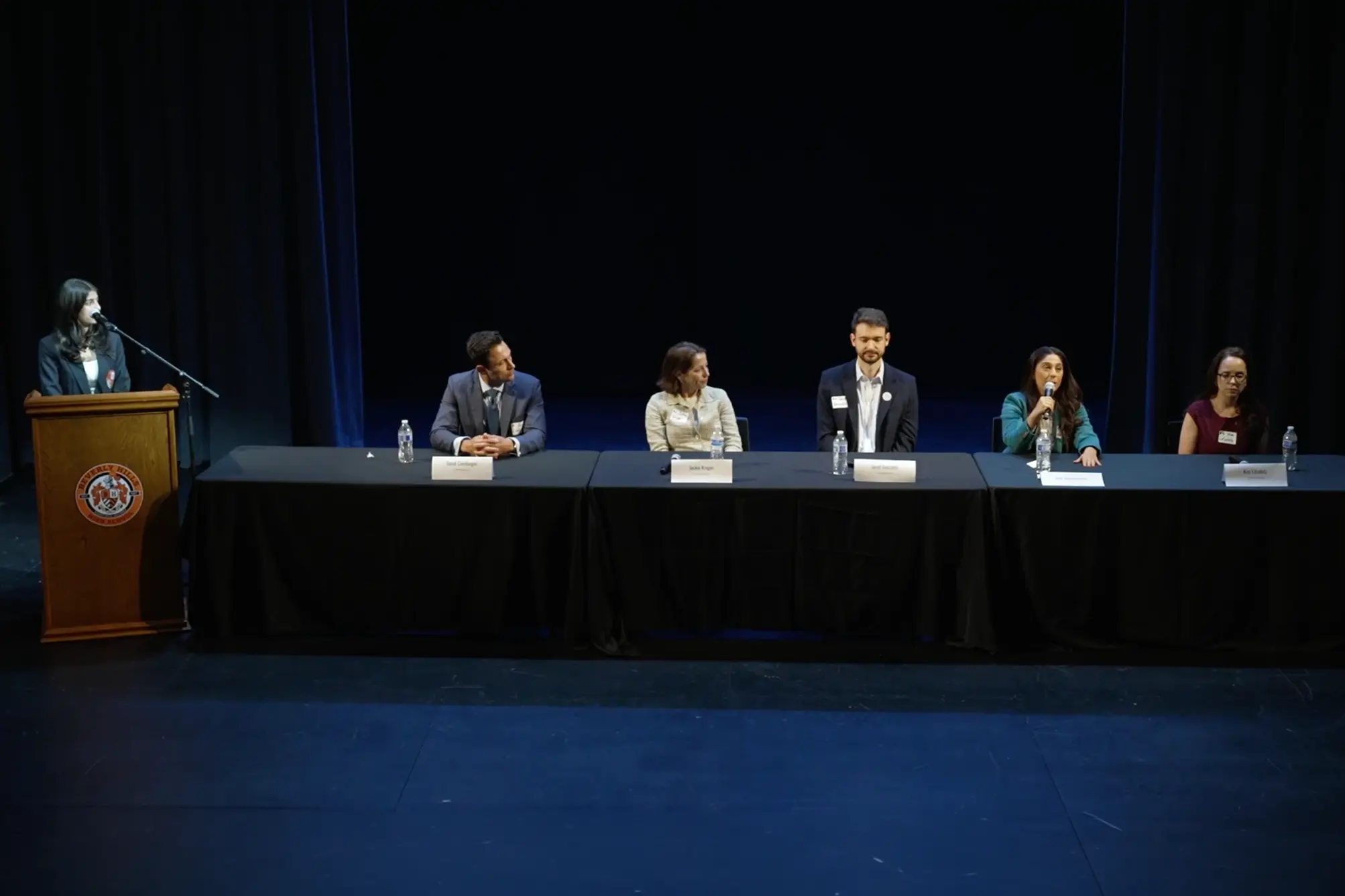
Beverly Hills High School students put five school board candidates through a useful test Monday night: explain what you would do for the students sitting in front of you. By the end, the distinction was clear. Some answers connected ideas to specific decisions and programs. Others relied on good intentions, personal stories, or criticism without a corresponding plan.
The October 5 forum, organized by Associated Student Body and Career Academy students, covered artificial intelligence, student feedback, school priorities, career opportunities, and academic pressure. These were practical questions about the education students receive and the decisions adults make on their behalf.
Judged on the substance of those answers, incumbent Board President Judy Manouchehri delivered the strongest overall performance.
Her advantage was specificity. On student feedback, she described how students' concerns about communication and scheduling helped shape a compromise allowing high schoolers to retain their phones while restricting their use during instruction. On career preparation, she proposed additional pathways in sports and talent management, nursing, and real estate and construction. On academic pressure, she identified counseling and tutoring services across school levels.
An incumbent naturally has more completed decisions to discuss. That alone should not win a forum. What distinguished Manouchehri was her ability to connect those decisions to the questions being asked.
Her answers still deserved scrutiny. Describing careers as immune to artificial intelligence was too absolute. Claims that district initiatives are nationally unique require evidence. Listing existing services also does not answer every question about whether students can access them promptly or whether additional support is needed. But she gave voters identifiable policies and proposals to examine.
Kimberly Lifschitz offered the strongest challenge on the less visible pressures students face. Her discussion of high-achieving students who conceal distress or resist asking for help was one of the evening's most thoughtful answers. She also proposed a teaching pathway connected to the district's early childhood initiative and argued that students should see how their feedback affects decisions.
Those were substantive contributions. Her proposed moratorium on generative AI, however, needed considerably more explanation. What would it prohibit? What exceptions would apply? How would students develop practical skills while learning to recognize the technology's limitations? A restriction is a policy choice, but it still needs an educational plan.
Jared Gonzales brought a classroom perspective and explained the relationship between support, expectations, and resilience. His proposal for board office hours gave substance to the promise of listening. His account of reducing technology in math instruction also explained a tradeoff rather than simply declaring technology good or bad.
Too often, however, collaboration became the destination of his answer rather than the beginning of a decision. Consulting people matters. Voters also need to know what a candidate would recommend after those conversations. His joke about directing student complaints to a trash can, though explicitly presented as a joke, was an unfortunate introduction to a question about taking student voices seriously.
David Cienfuegos maintained a clear focus on academics, useful technology, and access to opportunities. His proposal for walk-in after-school tutoring across achievement levels was concrete and worth examining. His internship answer explained why exposure to a profession before college can help students make better choices.
But several answers stopped at desirable outcomes. More resources, better internships, and substantial weight for student opinions are sensible goals. The next question is how to provide them, resolve competing priorities, and measure whether they work.
Jackie Kruger offered useful ideas about drawing on parents and local businesses, exploring UCLA laboratory access, and providing spaces where students can manage social and emotional stress. Her closing statement nevertheless shifted from those ideas to sweeping claims about academic decline and financial management.
Kruger named Santa Monica, Palisades Charter, Malibu, and Culver City while arguing that Beverly Hills had fallen behind. That comparison cannot simply be dismissed. Published accounts of the 2024 U.S. News rankings placed all four above Beverly Hills High School. The ranking gap is a legitimate subject for public discussion.
But her conclusion that students are performing progressively worse each year was not established by the ranking positions she cited. California's official results show BHHS's English proficiency rate increased from 61.73% in 2024 to 67.27% in 2025, while math increased from 48.20% to 52.14%. In 2025, BHHS exceeded Culver City and Malibu in math proficiency, although Santa Monica remained higher in both subjects.
These figures do not erase the ranking gap. They do make a blanket account of continuing deterioration inadequate. A candidate making that argument should explain both the comparative weaknesses and the newer gains.
Her financial criticism also needed precision. She cited a $6 million shortfall last year and a projected $3 million shortfall this year, then characterized those amounts as overspending. She did not identify the financial reports or distinguish spending beyond revenue from spending beyond an approved budget. Her assertion that BHUSD spends one-and-a-half to twice as much per student likewise came without a consistent comparison of years, entities, and expense categories.
Those omissions do not establish that her figures were false. They establish that her closing did not demonstrate the financial case she was asking voters to accept. Nor did it identify specific spending changes that would address the concerns she raised.
The students deserved direct answers, and voters deserve the same standard. Criticism is part of running for office. The responsibility is to make it precise, acknowledge evidence that complicates it, and explain what would change under your leadership. Manouchehri most consistently met that standard Monday night. Every challenger offered something worth considering, but identifying a problem and presenting a workable response remained two different achievements.



Join the Conversation
Comments are available exclusively for registered subscribers. Sign up to read comments and share your thoughts on this article.
Get access to exclusive content, breaking news, and community discussions.