


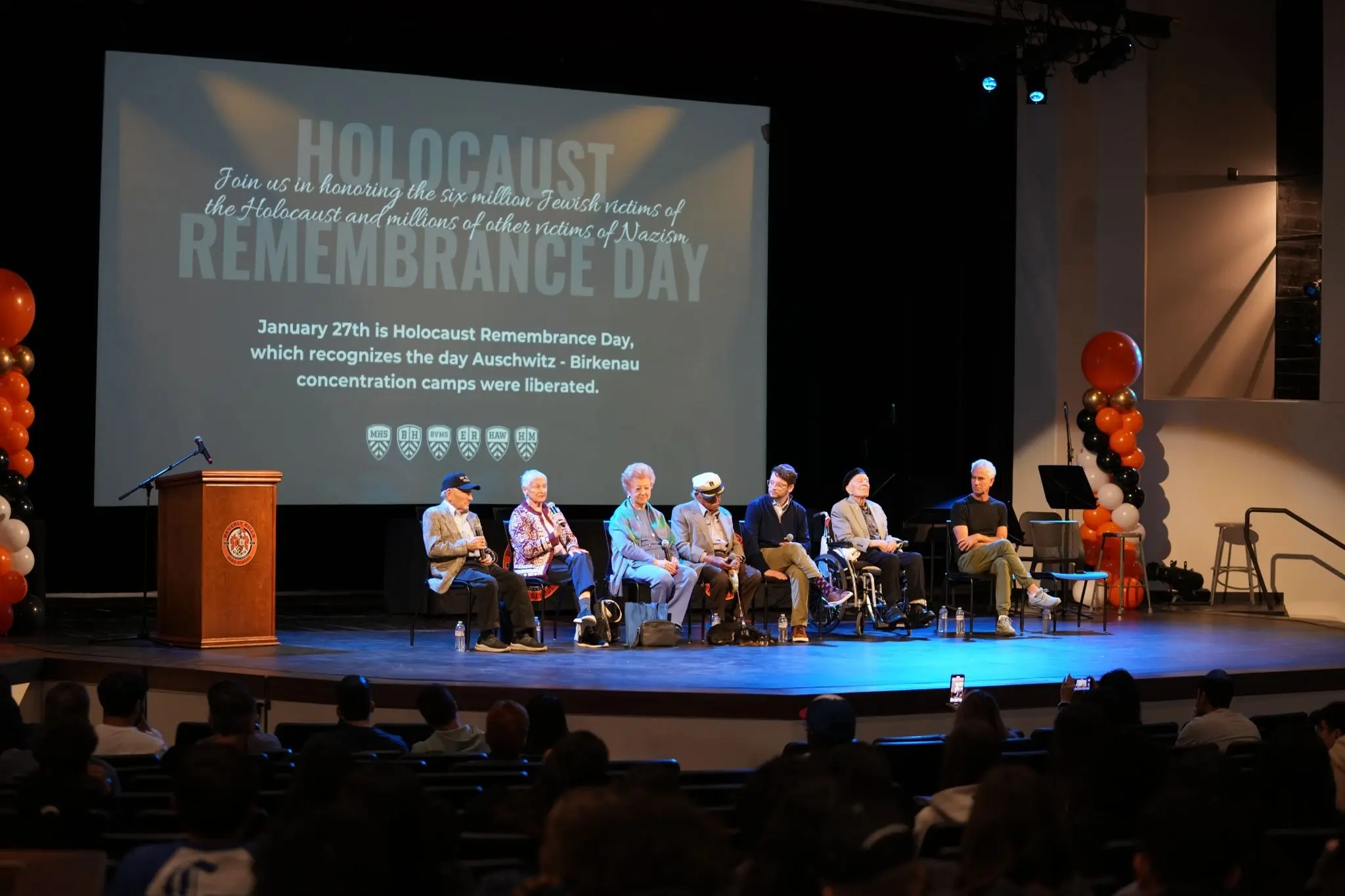
Beverly Hills High School gathered as a full student body for the first time in the newly completed K. L. Peters Auditorium on January 27, 2026, marking International Holocaust Remembrance Day with an assembly centered on living history, survivor testimony, and the responsibility of memory.
The event brought Holocaust survivors and scholars to campus, offering students direct engagement with primary sources at a moment when firsthand testimony is becoming increasingly rare. The assembly formed part of a districtwide observance where speakers traveled to all four BHUSD campuses to share their experiences with students across grade levels.
Principal Loan Sriruksa addressed the significance of the moment for students navigating a media landscape shaped by disinformation and historical distortion.
“Our students are living in a world where disinformation is widespread, and firsthand knowledge is more critical than ever,” Sriruksa said. “This assembly brought history to life in a way no textbook could. It challenged our students to think deeply, feel compassion, and ask questions rooted in curiosity and truth.”
Joseph Alexander, 103, survivor of twelve concentration camps, speaks to BHHS students at the International Holocaust Remembrance Day event on January 27, 2026

Students heard from Joseph Alexander, 103, who recounted surviving twelve concentration camps while his family was killed during the Holocaust. Eva Pearlman shared her childhood escape from Nazi persecution, an experience often compared to the story of Anne Frank. Susanne Reyto, an educator and representative of Violins of Hope, spoke about the restoration of Holocaust-era violins as living vessels of memory. Abraham Yardeni, 96, described growing up amid constant threat during the years of British rule prior to the establishment of the State of Israel. Joseph Samuels spoke about surviving the Farhud, the 1941 Nazi-aligned pogrom in Iraq. Scholar and moderator Shabbos Kestenbaum provided historical framing and ethical context for the testimony presented.
Following the assembly, students engaged in small-group discussions with the guests, took photos, and thanked the speakers for sharing their experiences. Faculty members noted the level of attention and reflection among students throughout the program.
“These stories are not just memories. They are lessons that will shape how our students think, lead, and live,” Superintendent Dr. Alex Cherniss said. “We are grateful to the survivors for trusting our students with their truths. In moments like this, education becomes moral action.”
The assembly marked a defining moment for the K. L. Peters Auditorium as a space for collective learning and reflection. Its first full-school gathering centered on remembrance and moral responsibility, setting a tone for how the venue will serve the campus not only as a performance hall, but as a forum for civic and historical education.

Join the Conversation
Comments are available exclusively for registered subscribers. Sign up to read comments and share your thoughts on this article.
Get access to exclusive content, breaking news, and community discussions.