


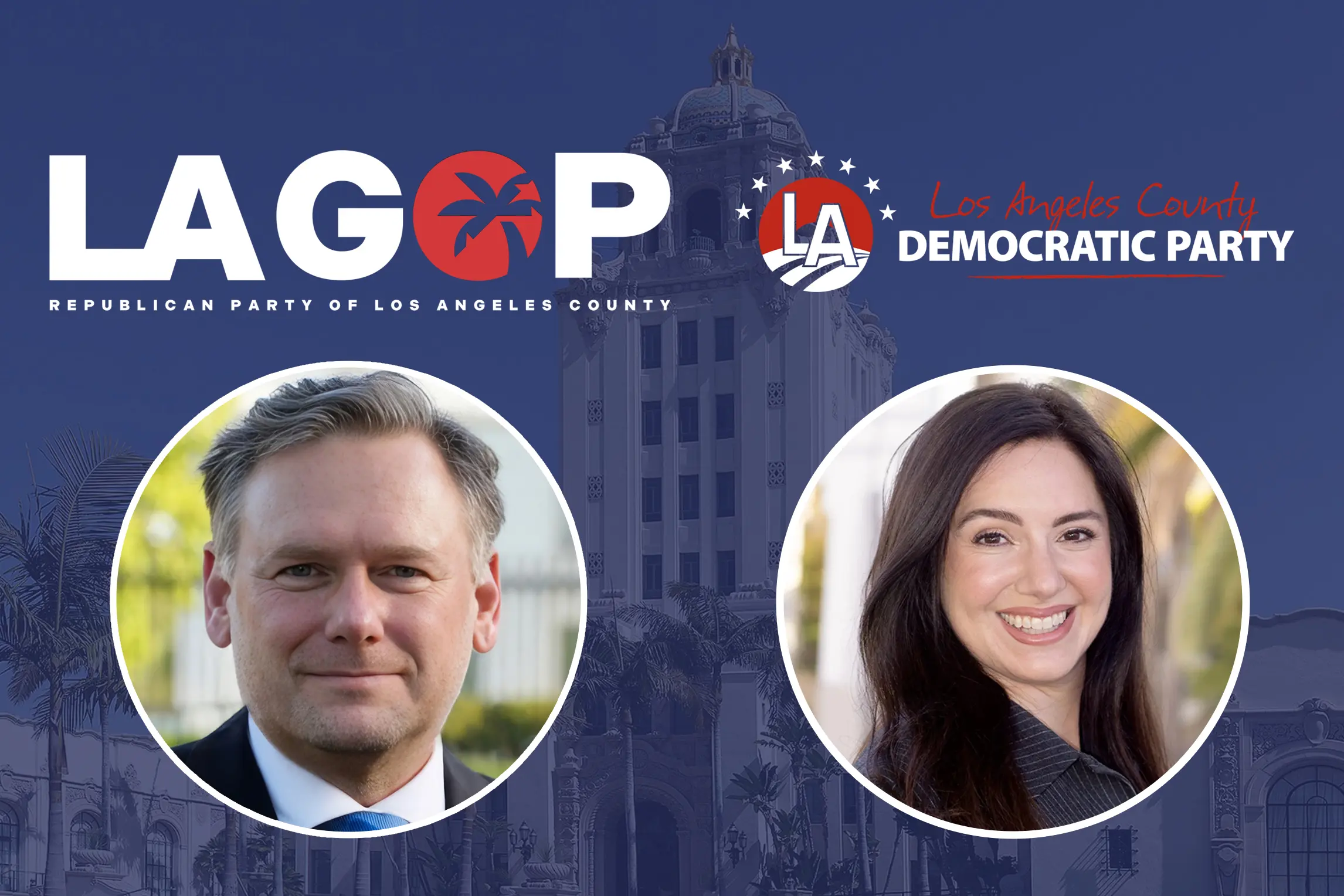
The race for Beverly Hills City Council is beginning to take clearer political shape, with Russell Stuart receiving the endorsement of the Republican Party of Los Angeles County and Rebecca Pynoos gaining Democratic support as two leading candidates seek to define the contest for the open seat being vacated by Councilmember John Mirisch.
Although Beverly Hills municipal elections are officially nonpartisan, the endorsements signal the political stakes behind a race that will help determine the future direction of City Hall. In a city where public safety, development, housing mandates, business vitality and local control have become defining issues, party support offers voters another lens through which to evaluate the field.
Stuart, a Beverly Hills Unified School District Governing Board Member, business owner and public safety advocate, received the backing of the county Republican Party as he campaigns on a platform centered on law enforcement support, small business protection, neighborhood preservation and stronger local control.
“Congratulations to Russell Stuart on receiving the endorsement of the Republican Party of Los Angeles County. Russell understands that strong communities are built through public safety, economic strength, and leadership that respects the values and standards residents expect,” said Roxanne Hoge, Chairwoman of the Republican Party of Los Angeles County.
The endorsement gives Stuart one of the most significant conservative organizational boosts in the race. It also places him in direct alignment with a voting base that remains highly relevant in Beverly Hills. In the 2024 presidential election, Beverly Hills voted 51.44 percent for Donald Trump and 46.60 percent for Kamala Harris, with Trump receiving 8,968 votes to Harris’ 8,123 votes.
That result stood in contrast to the broader political alignment of Los Angeles County and California, where Democratic candidates continued to dominate at the presidential level. Beverly Hills, however, showed a more conservative pattern, reflecting a local electorate often focused on public safety, quality of life, taxes, business conditions and resistance to one-size-fits-all state housing policies.
Pynoos, chair of the Beverly Hills Architectural and Design Review Commission and a third-generation Beverly Hills resident, has also emerged as a major contender. Public posts from Westside Young Democrats show the organization endorsing Pynoos for Beverly Hills City Council, reinforcing her position as a leading candidate with support from Democratic-aligned groups.
Pynoos has built her campaign around resident-focused leadership, design review experience, historic preservation, renters, younger residents and a new generation of civic engagement. Her candidacy has drawn attention in a crowded race that includes two incumbents seeking reelection and multiple challengers competing for three seats.
The endorsements highlight a central reality of the Beverly Hills election. The ballot may not list party labels, but local values often track with broader political philosophy. Candidates are being judged not only by experience and personal reputation, but by how they approach public safety, business confidence, housing pressure from Sacramento, neighborhood character and the role of government in daily civic life.
Mirisch, who has served multiple terms on the Beverly Hills City Council and as mayor, has long been associated with Republican politics. His departure creates the clearest opening on the five-member council, and the competition to succeed him has become one of the most important dynamics of the June 2026 race.
For Stuart, the Republican Party endorsement strengthens his argument that he is the natural fit for voters seeking continuity on public safety, local control and conservative-leaning civic priorities. For Pynoos, Democratic support helps solidify her standing among voters looking for a different generational and policy perspective at City Hall.
Both candidates now enter the next phase of the campaign with major political signals behind them. In a city where voters can select three candidates, the endorsements may help organize the race around two distinct but serious contenders, each representing a different lane in Beverly Hills politics.
The broader question for voters is not whether the race is partisan on paper. It is whether the future of Beverly Hills will be shaped by candidates who reflect the values residents believe are most important at this moment. As the city faces major decisions over public safety, the Metro opening, development pressure, small business recovery and the protection of neighborhood identity, the political center of gravity in the race is becoming harder to ignore.

Join the Conversation
Comments are available exclusively for registered subscribers. Sign up to read comments and share your thoughts on this article.
Get access to exclusive content, breaking news, and community discussions.