


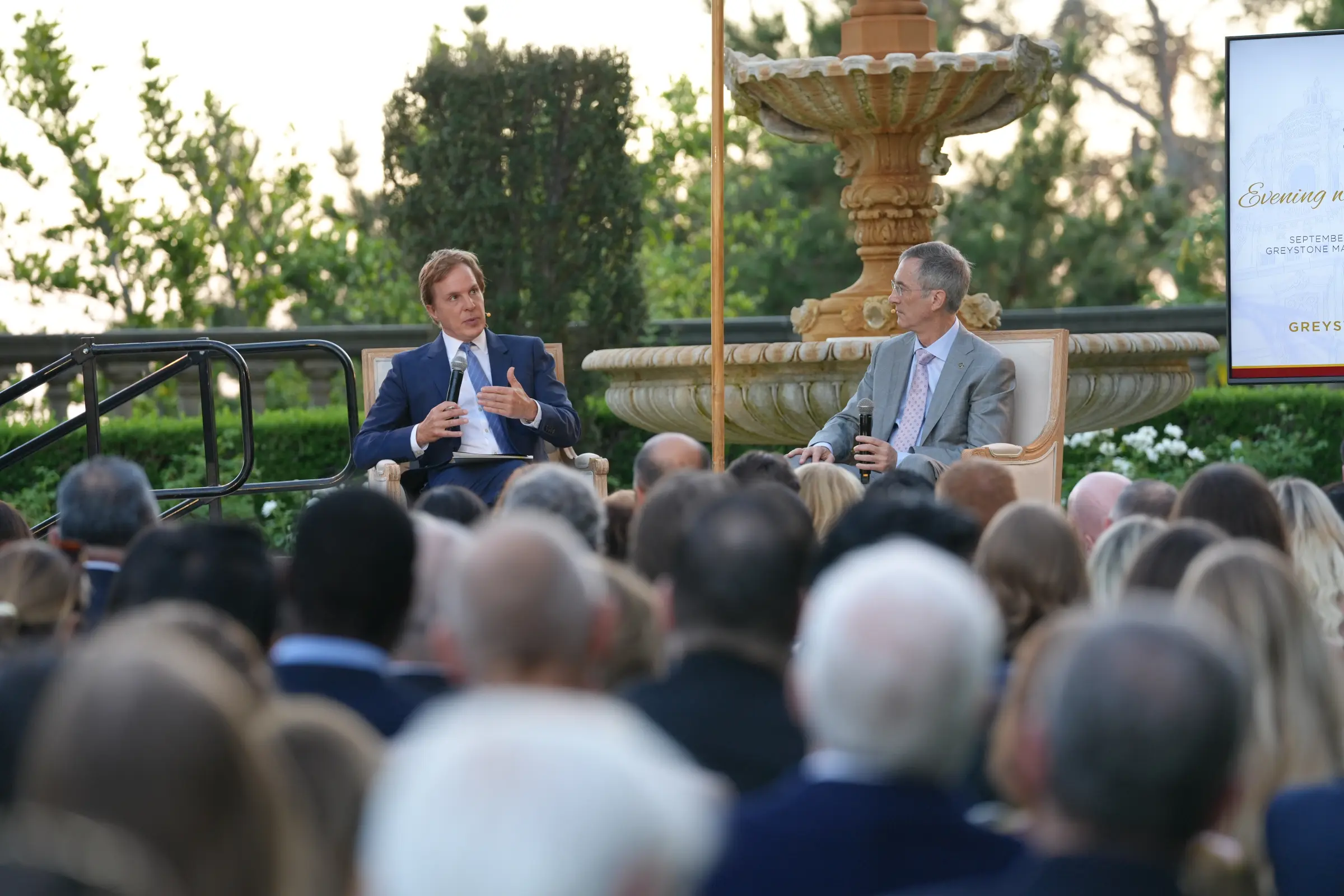
Beverly Hills Mayor Craig Corman put public safety, fiscal responsibility and continued business investment at the center of his State of the City discussion September 23 at Greystone Mansion, outlining the city's priorities during an evening that also included tributes to colleagues and community members who had died.
Hosted by the Beverly Hills Chamber of Commerce in partnership with the city, "An Evening With the Mayor: State of the City 2026" brought together residents, business leaders and public officials for a conversation between Corman and NBC4 anchor and reporter Robert Kovacik.
Before discussing city business, Corman turned to Kovacik with a personal message of sympathy over the deaths of aerial journalist Eliana Moreno and pilot George Marciniw in the previous week's helicopter crash.
"I just wanted to let you know how very sorry we all are here in Beverly Hills for the loss of your two colleagues," Corman said.
The mayor acknowledged the close relationships within the NBC4 newsroom and extended condolences to Kovacik, his coworkers and the families of Moreno and Marciniw.
"We know you're all hurting," Corman said.
That acknowledgment preceded a wide-ranging discussion of the mayor's first six months in office, the city's financial position, major development projects, transportation, housing and preparations for the 2028 Olympic and Paralympic Games.
Corman identified the city's budget outlook as one of the council's principal accomplishments. When he and Vice Mayor Mary Wells were elected in 2024, he said, the city faced a projected deficit of approximately $24 million for the coming fiscal year. He credited spending management and careful use of city resources with changing that outlook to a projected surplus of approximately $100,000.
"It's a small surplus," Corman said, while describing the turnaround as "a big accomplishment of the council."
He also highlighted a new four-year joint powers agreement with the Beverly Hills Unified School District. The arrangement provides city access to school facilities and funding to the district, while moving operation of the city's preschool program to BHUSD.
Corman described the preschool transition as an opportunity to introduce families to the district and encourage them to continue into its other schools.
The mayor also pointed to leadership transitions at City Hall and within the Police Department, welcoming Ryan Golik as city manager, Stephanie Harris as assistant city manager and Max Subin as police chief. He praised the community's reception of Subin and joked that the chief's installation drew more people than his own.
Asked by Kovacik what continues to attract investment to Beverly Hills, Corman placed public safety at the top of the list.
"Our city council has a philosophy that, if you don't have safety, you don't have anything," Corman said.
The mayor said police and fire account for more than half of the city's general fund spending. He described that investment, together with the city's hotels, restaurants, schools and reputation as a luxury destination, as central to its appeal.
Corman discussed continued development of police technology, including the Real Time Watch Center, a network he said includes more than 3,000 cameras, and the department's drone program. He said the city is developing autonomous drone capabilities that would allow aircraft to land, recharge and take off again, and is examining technology to address potential drone threats ahead of the Olympics.
"The police department comes up with these initiatives, and we support them every step of the way," he said.
Corman also expressed support for pursuing state authorization for additional automated traffic enforcement, describing discussions with Assemblymember Rick Chavez Zbur about the issue.
On economic development, the mayor cited One Beverly Hills and the planned Louis Vuitton flagship project as examples of substantial investment in the city's future. He described plans for the Louis Vuitton development to combine retail with exhibition space and a restaurant.
Corman stressed the relationship between the business community and residents, saying commercial activity generates revenue that helps pay for city services.
"We are extremely welcoming to businesses," he said.
Transportation was another focus. Corman said a future Metro station in the heart of the city's business district would create new opportunities for shopping and dining, including easier access for people working in Century City.
He also promoted "Metro with the Mayor," his effort to introduce residents to destinations they can reach by rail. An initial outing took participants to Dodger Stadium, and he said another trip was planned for a November matinee at the Ahmanson Theatre.
"No matter how much money you have, if you could go downtown in 20 minutes instead of an hour and 20 minutes, you're gonna take that Metro," Corman said.
The conversation also addressed housing, with Corman describing the challenges posed by state requirements and projects submitted under the builder's remedy during the period when Beverly Hills lacked a certified housing element.
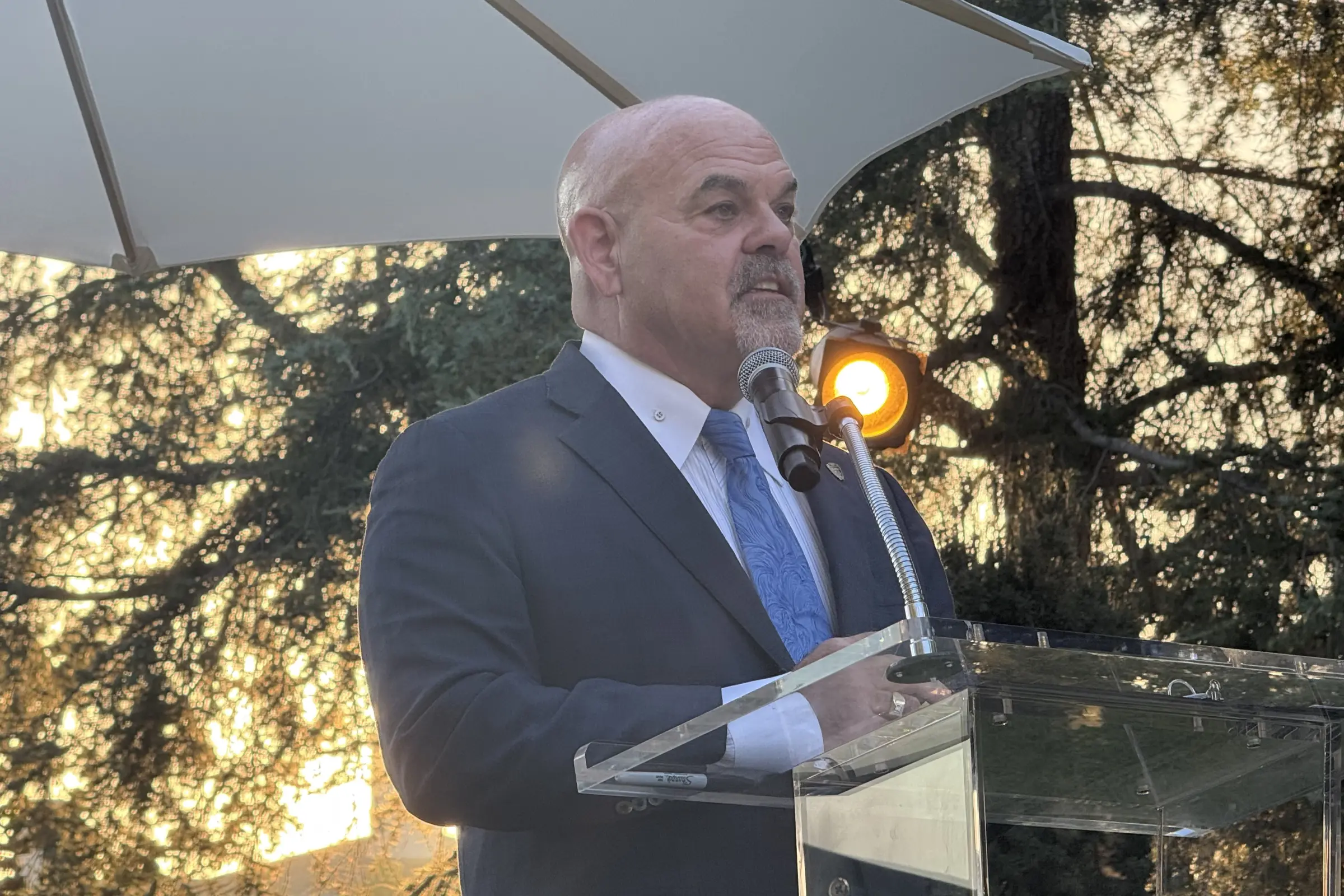
 Beverly Hills Chamber of Commerce President and CEO Todd Johnson serves as master of ceremonies at the State of the City event at Greystone Mansion on September 23, 2026.
He said maintaining certification remains a priority and connected that goal to the city's efforts to develop affordable housing on city-owned land. He discussed plans for approximately 70 affordable units at 327-335 South Robertson Boulevard and the purchase of another property at 401 South Robertson Boulevard for potential additional housing.
"It's important that we continue to look at building affordable housing to make sure our housing element remains certified so we can maintain control over our neighborhoods," Corman said.
Turning to cultural programming, Corman discussed "Beverly Hills Masters," his podcast featuring conversations with chefs behind the city's restaurants. He cited interviews with Wolfgang Puck and Puck's son Byron among the opportunities to introduce audiences to the people behind the dining experience.
He also described plans to bring 10 sculptures by artist Carole Feuerman to Rodeo Drive, presenting the installation as a possible starting point for a rotating series of fine art exhibitions.
"I think it would be great to turn it into an outdoor exhibition, almost a museum," Corman said.
With the 2028 Olympics approaching, Kovacik asked how Beverly Hills would prepare for an influx of visitors seeking its hotels, shops and restaurants.
Corman said planning was underway for visitor programming and security, and that the city would play a hospitality role even without serving as a principal competition venue. He said hotels were already approaching capacity for the Games and expressed interest in the possibility of the torch relay passing through Beverly Hills.
"We're going to show them what it's about," Corman said of visitors coming to experience the city.
Kovacik summed up the mayor's outlook with a brief observation.
"Beverly Hills, bring it on," Kovacik said.
"Absolutely. We've got game," Corman replied.
Looking ahead to the remainder of his mayoral term, Corman said business recruitment would continue through planned trips to New York and Miami. He also emphasized the value of cultural attractions and public programming that give visitors additional reasons to spend time in Beverly Hills.
The evening opened with remarks from Chamber President and CEO Todd Johnson, who emphasized the event's role in connecting the city and its business community.
"It's a tradition that we bring our city government, our business community, and our residents together for this event," Johnson said.
Johnson thanked city staff, Chamber employees, sponsors and community partners. He also recognized retiring Fire Chief Greg Barton and presented him with a dinner gift for Barton and his wife.
When Johnson overstated the chief's tenure, Barton supplied a brief correction.
"31," Barton said.
Johnson thanked Barton for those 31 years with the city and for his leadership and friendship.
The Chamber president also remembered Judie Fenton, asking attendees to keep her family and friends in their prayers.
"She was an amazing lady," Johnson said, describing Fenton as "a dear, kind soul."
Chris Rivielle, president and CEO of presenting sponsor Plant Construction, spoke about his decision to live and locate his business in Beverly Hills, citing public safety and the city's business environment.
Rivielle also reflected on losing five schoolmates in the September 11 attacks and on a recent visit to his hometown in New York. He shared advice from a friend who lost two brothers.
"Appreciate the small things," Rivielle said.
He urged attendees to value ordinary evenings spent eating dinner with family and called on business leaders to care for their employees.
"Be generous, be thankful, love your family," Rivielle said.
Chamber Board Chair Stephanie Cohen, a Cedars-Sinai vice president, introduced Kovacik and Corman. She also shared her longstanding personal connection to the NBC4 journalist.
"I also happen to have known him since I was seven years old," Cohen said.
Welcoming the audience, Cohen thanked attendees for gathering to celebrate Beverly Hills and the community that makes it a special place to live and work.
For Corman, those personal connections were also among the rewards of serving as mayor.
"I've had the opportunity to meet a lot of people in the last six months," he said. "People in our community, people in our business community, and it's been a wonderful experience."



Join the Conversation
Comments are available exclusively for registered subscribers. Sign up to read comments and share your thoughts on this article.
Get access to exclusive content, breaking news, and community discussions.